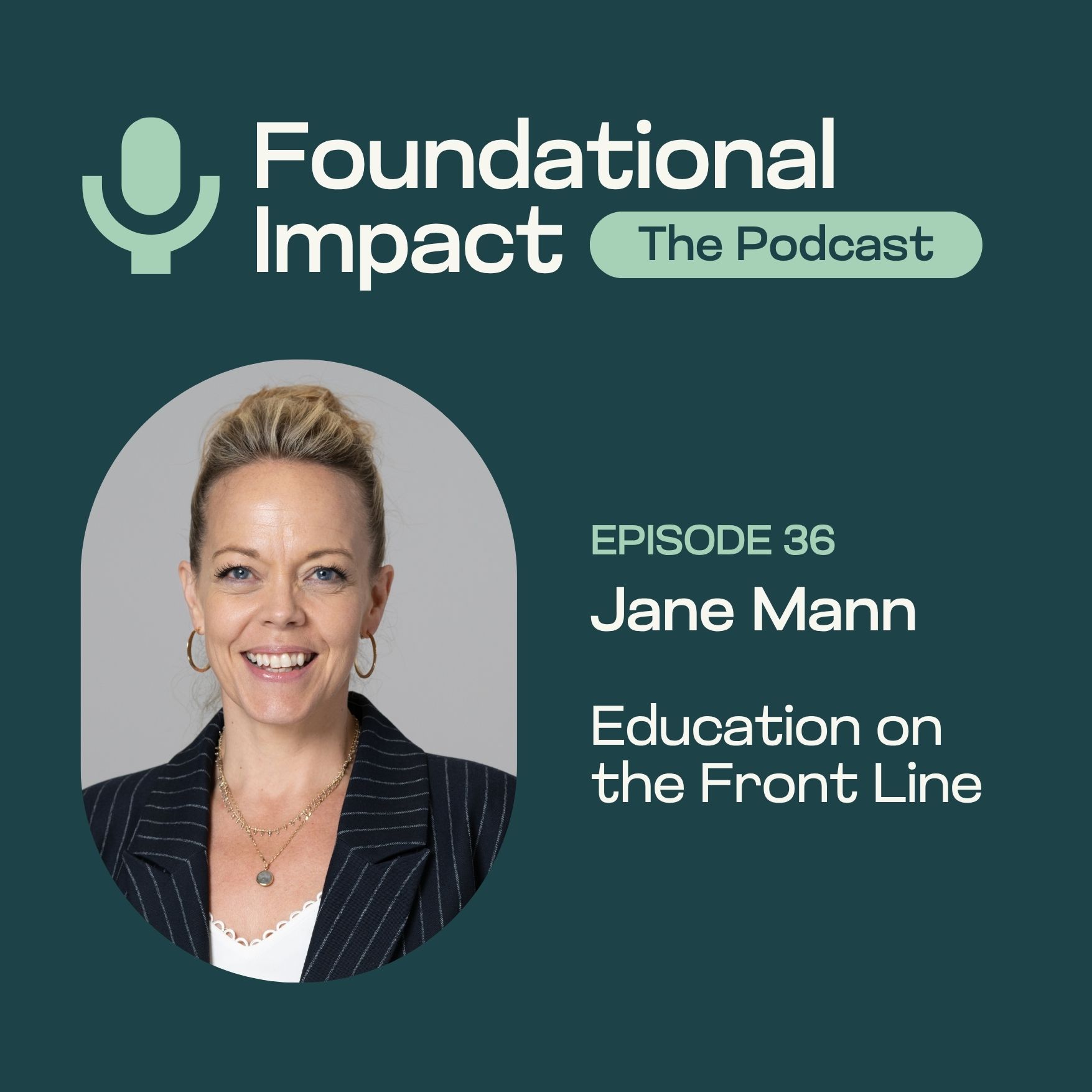
Jane Mann: Education on the Frontline

June 6, 2026

Transcription

Daniel Emmerson 00:01
Welcome to Foundational Impact, a podcast series that focuses on education and artificial intelligence from a nonprofit perspective. My name is Daniel Emmerson and I'm the Executive Director of Good Future Foundation, a nonprofit whose mission is to equip educators to confidently prepare all students, regardless of their background, to benefit from and succeed in an AI infused world.
Daniel Emmerson 00:28
Welcome everybody to Foundational Impact. It's an absolute pleasure and privilege to have Jane Mann with us here today. Jane is the Managing Director of the Partnership for Education and Education Director for International Education at Cambridge University Press and Assessment. Jane, thank you so much for being here. How are you doing today?
Jane Mann 00:49
I'm good. It's beautiful out there. It's such a sunny day. I'm not out in it yet, but I'm looking forward to it later.
Daniel Emmerson 00:55
Very, very glad to hear that. Also looking forward to experiencing some sunshine. But before we get to that point in our week, I'm delighted to be able to have you here to talk through multiple aspects of your work. I think you do. It seems so, so much in the partnerships and in the assessment space, but to sort of unpack a little bit of that through the lens of AI is our objective here. Before we get into that, though, could you tell us a little bit about what it means to be the Managing Director of the Partnership for Education and Education Director for International Education?
Jane Mann 01:33
I have two hats, unfortunately, these are figurative hats, not actual hats that I'll put on. So as Managing Director of the Partnership, I have the enormous privilege of leading the team in Cambridge that works directly to government or directly to donor agencies, international development organisations, on programmes of education transformation. So these will usually be either programs working with ministries of education on things that they want to change within their system, and that may be driven by many things, many disruptors, many opportunities, things that they want to tackle, but obviously all towards improving outcomes in some way.
Daniel Emmerson 02:14
Can we get an essence of. Because you work across so so many countries, more than 20 countries on a regular basis.
Jane Mann 02:21
Oh, yeah. So our portfolio at the moment is probably around 30 countries at the moment. I think we've worked with 74 governments and our programs vary in scale. So sometimes it will be really holistic, like we are going in and working with that government and the stakeholders on curriculum, assessment, teacher development, materials. There'll be a whole thing. Say for instance, in the Sultanate of Oman, we did maths and science from grade 1 to 12 with them, the whole thing, and it was amazing. Other times it will be a small policy intervention. So we want to make sure that the policy that we have around With AI regulation, for instance, we started working on how should great AI frameworks show up in policy. In Bhutan, at the moment, we're working with them on trying to get their grade 12 first of all and then grade 10 up to international standards. But typically it will be a real sort of under the bonnet, getting in there. We start with the what's going on, roadmap it, work out what they can do, and then we roll our sleeves up. And that's the really privileged part of getting involved in the implementation. We also do that work in education in emergencies contexts. So we'll work in fragile contexts. Like we work in the Cox's Bazaar refugee camp in Bangladesh with the Rohingya communities there. And that's around really basic, great stuff in education, like great formative assessment. How do you get that into those learning spaces? We work in Ukraine. In fact, today I've got 23 school leaders from Ukraine in Cambridge today. They've been here all week and I don't want them to go home because they've just been amazing, the energy that they've brought. So we also take that same work into these spaces. We've worked on programs of learning in Afghanistan. And to be honest, it's because every great education system needs the same ingredients. The way you deliver it might be incredibly changed by context. But fundamentally a coherent system that's working across curriculum, assessment, supported teachers, great school leaders, great materials that all needs to come together to deliver more. So that's Managing Director of the Partnership for Education,
Daniel Emmerson 04:39
Which is massive in itself, of course. And when you're working across so many different countries, let's take the example that you mentioned in Oman, a huge amount of cultural context will come into play, I guess, in each of these situations. How do you make sure that when you're looking at transformation, that the cultural aspects of the work that you're doing are comprehensive and fully integrated into what it is you're transforming?
Jane Mann 05:07
It's critical because not only are these national programs that need to look and feel local and representative of local identity, but also from a pedagogical perspective, children learn better in environments that are familiar and what they see in the materials needs to be set in a landscape that looks like theirs, unless you're deliberately trying to take them out of that. Just for everyday learning, so we have offices, we have a representation in 12 countries. We represent many, many languages. We work in pretty much any language. We're currently working on a qualification with the Mauritius Ministry of Creole Mauricio. I'm not yet fluent, but working on it. And the most important thing in terms of contextual relevance and proper implementation is local partners. We would not presume to be able to navigate these spaces from Cambridge. So we are always looking for really great, strong local partners who we can work with, who we can learn from to help deliver these programs and design the programs in a way that makes them feel really relevant.
Daniel Emmerson 06:13
We're going to move into some of the AI implications that you mentioned earlier on, but I think before we do that partnership is such a significant factor here. When you're working with those partners on the ground, how do you go about, first of all, finding the right ones to work with when it comes to, of course, due diligence, but also value alignment, credibility, and then sort of implementing that work and making sure it's sustainable in the long term?
Jane Mann 06:39
Values alignment is absolutely essential. I mean, it's a lot like dating, right? You need to know that you trust these people and that you can get along and that you probably make similar decisions even when the other one is not around. So the values and the principles come first because you need to be able to work with these partners in contexts that sometimes are really spiky. You know, ministry programs always come with really difficult deadlines. Quite often, in some of the contexts we're working in, it comes with complexity around where the work's being delivered. So you can't forge those relationships in the heat of the moment that has to already have happened. So the values alignment is really important. Also, the breadth of ingredients within any kind of reform or transformation program mean that we need to just really find those pockets of expertise. It might sometimes just be one small setup doing one small thing brilliantly, and that's exactly the bit that we need. But a lot of it is around. It's around trust, transparency, sharing values, both having the same aim, which is to support the ministry or whomever else it might be in getting to where they need to be.
Daniel Emmerson 07:57
How does that translate to those fragile communities that you mentioned, whether that's refugee camps or countries that are experiencing high levels of conflict?
Jane Mann 08:07
It becomes even more important than ever when we are delivering programs, particularly on the ground. And when I say we, I actually mean us and our partners, because in many of those places, we, Cambridge, can't be on the ground. There may be countries that we're unable to travel to for obvious reasons, and where the ability to deliver comes through a series of really carefully negotiated tiny little channels of possibility that can be seized upon in just the right way. So for that, you need partners who know the ground inside out. We also work a lot with UNICEF, with the Global Partnership for Education, with local and international NGOs who deliver. And usually in most contexts of education and emergencies, there will be a, already like a cluster on the ground, usually run by UNICEF, of all of the NGOs working at that time in that space. And it's to get coherence around delivery. So for us to be able to go through that cluster and make sure that we're not duplicating, we're not getting in the way, we're not somehow messing up something that was already in place, that's really important. It's so important for us to tread carefully in those spaces. And what we're bringing there is not the expertise in how you deliver an emergency program within a refugee camp. What we're bringing is what does the best possible education in that space look like? Because in those spaces, typically the children who are learning in them, the challenges they've had to overcome to get to that place already, they may be learning in a non permanent structure, a tent or something. There may be no space at home to continue that learning or indeed anything to take home to continue with. So you have to make sure that every moment that you have them, you're delivering something which is the most useful it can possibly be.
Daniel Emmerson 10:06
And that is going to vary substantially, I would have thought, when it comes to access to resources. What's available for bringing into a classroom? What young people are engaging with? How do you perhaps go about thinking through the role of technology, if at all, in these situations, particularly where there's a restriction on resources? Does it come front and center regardless of what you're doing? Is it there a tool, a mechanism, do you have to adapt from place to place?
Jane Mann 10:38
You definitely have to adapt. It is a tool. It's one of the tools that's available. Where it is available, it can be absolutely golden. But it does carry as, of course, you know, the risks of widening equity gaps. In some places, it carries actually the risk as well of greater vulnerability. So just having a device makes you more vulnerable because those things are valuable. But from a learning perspective, I mean, I’mI talking about the Ukrainian leaders we have in right now, their what they have learned in that country around hybrid learning, we need to all be watching because they have for the last four years been moving in and out of modes in some of those most affected areas of Ukraine. And without technology, without the ability to do that, for many of those children, learning would have stopped. So, and it's not just learning of course, it's the. It's the routine of school. It's the reassurance that in the morning you can wake up and switch on and you're going to see your friends and your teacher. And so in some places that has just been our literal lifeline.
Daniel Emmerson 11:43
And thinking about AI specifically, I'm wondering if that's played into the Ukrainian context. How frequently are you coming across AI as a challenge or an opportunity? What does that look like?
Jane Mann 11:58
It looks like both a challenge and an opportunity. I'll give you some examples of the ways in which we're working with governments in AI at the moment, because they vary, but they're also showing something quite interesting, I think. So we are working on things like what should the regulatory environment be around? Not kind of big regulatory, but within an education system, what are good policies to have around AI? So that's really encouraging. Lots of teacher development, which is really encouraging because when I first came into this line of work 150 years ago, it was traditional that you'd see a tender document come in and it would be asking for loads of stuff that was new. And then at the bottom there might be like a, oh, could you do a bit of teacher training as well? The whole thing should have been flipped. You start with the teachers, right? And we're really seeing that with AI. So we are delivering, along with another mutual friend, Professor Rose Luckin's team at EVR, we're delivering programs of AI education to teachers and school leaders. And in some contexts, actually the people that they've got together into the room may be from kindergarten to further ed, higher ed. So some of these elements are really common around what is an ethical, effective, relevant way to be using AI. So lots of teacher education. And we're starting now as well to see really useful ways to use AI in, for instance, mapping curricula. What does this one look like next to this one? How aligned is my curriculum with my textbook? How is my physics curriculum running at the same pace as my maths curriculum? Because if it's not, I'm going to get to the point where the physics doesn't make sense because I haven't got the maths yet. So very little. Please can you put some AI into your resources and much more. How can we work with this thing so that it's doing the heavy lifting? There's also, we're looking at things like great teacher development tools that. Not teacher development, teacher lesson planning tools that can be on a mobile device in places like Sub Saharan Africa. And there you need to be looking at issues of things like language, what language does it need to be delivered in? Are those languages that they're typically trained in? But yeah, it's more about how can AI make the role of teaching and the creation of the tool, the things that we need for teaching and learning, better, rather than put it into the thing that the student is interacting with. Now, that's just our experience. I know that others are focused very much on having AI in the product, but I feel quite reassured by that at the moment.
Daniel Emmerson 14:52
So thinking about that professional development in particular, I mean, we have the privilege as well, I suppose of working in different countries around the world and supporting schools in multiple contexts when it comes to AI and professional development. And the need varies substantially from place to place. We often find that the first thing that school leaders think they want is a list of tools that they can use for certain subjects. Where in fact it's the EVR approach, thinking about purpose first, that always triumphs in the end because once you start with that, everything else seems to follow. I'm wondering about your experiences at a transformation level when you get those proposals in, how much of it is, okay, we would like to start with teacher training, but it's training on these particular products or is it more focused on outcomes? Or is there a real sense of purpose there from the start?
Jane Mann 15:53
There is a real sense of purpose, but the purpose is not narrow. So it's not just we want teachers to be using more AI in the classroom in order to get better outcomes. I think there's much more of a sense at the moment that AI is such a nebulous thing. The way in which you could use it as a school leader or a teacher, you could simply use it in your classroom management work, you could use it for your budgeting. There are so many ways in which you could be using AI that really a lot of what we're asking for, a lot of what we're asking for is what is the evidence, how do we work with it, how do we bring our specific problems to it and solve those problems with it? And also I found this really interesting. We run a program of executive education for policymakers called the HP Cambridge EdTech Policy Fellowship. And we take these groups of policymakers with our partner HP and we take them through a five month program of learning from the evidence. It's kind of three pillared. We work with the evidence, they bring a project which they are, or a problem that they're trying to solve and we use that as their life space to learn through. But the one pillar which has been critical and which if I'm absolutely honest, I didn't necessarily think would be is leadership. Because nobody can claim to know everything about AI or ed tech. Everybody is in a bit of a kind of. Well, they're on a spectrum but most people are kind of trying to find their way. And what you really need to be able to do in that is to be able to say I understand what we need, I've done the work and I can see what might be able to help us with that. And now I'm going to lead us all through this change in a way that everybody can end up feeling effective, supported, enabled. And so to get those coalitions of change, particularly at policymaker level, are critical. So we're seeing a lot of the desire to learn more about the skills, things like leadership and not just the AI itself. And I think that is reflected in the classroom. You know, what we need to be doing to be teaching effectively about AI is to be teaching effectively about communication and self management collaboration. How to ask a great question, it's not simply about how does the AI work and which tools should you be prioritising for which tasks.
Daniel Emmerson 18:24
And you mentioned policy a couple of times, Jane, can you tell me about where some of the best policies that are out there are coming from and how those are implemented?
Jane Mann 18:34
We're seeing some really careful policy making coming from all over really. But so we've worked with some of the Gulf countries on this and you know, because they are quite often quite far ahead with the technology, I think they're seeing the need to make sure that implementation is thought through, is careful, is sustainable. So definitely there. I think that countries where, countries like Singapore, we work with Singapore, again we're seeing really thoughtful. It's another Rose-ism, isn't it, that you should think slow and act fast. We're seeing a lot of thinking slowly and acting quickly, which is good. Naturally a lot of the action is coming from those higher resourced contexts. But some of the most interesting conversations I've had around AI and policy and what to be careful about have not necessarily come from those contexts. So some of the countries that are involved in the EdTech Hub, AI Observatory, the minister from Sierra Leone, Conrad Saki, the way that he's thinking about what AI should and shouldn't be doing and how to make his education system really efficient so that it's used really carefully in the spaces where it can deliver the most value without. Yeah, without having to kind of widen equity gaps or make assumptions that just aren't realistic.
Daniel Emmerson 20:03
So how does that work then for you? Would he approach Cambridge and say, this is what I want to achieve this efficiency at a systemic level, and then you sort of work through that problem?
Jane Mann 20:16
So in some cases, and we found out this morning actually that we have just won an opportunity in a Gulf country to work on AI teacher education, which is wonderful. It's nice news for a Friday. And that was through a tender, through a public tender, but it was with a country that we've worked with extensively in the past. The thing about a tender is that you absolutely need to be as far away as possible from the creation of it, but you need to understand where it's coming from and that it's probably coming because you need that context in order to be able to come up with a proposition which will work. So sometimes it will be a tender, sometimes it will be a relationship that we already have with a country. I mean, we've been working with Singapore for a very, very long time. I think about 80 something years, I probably got that wrong, but a long time. And in that case, they are almost sort of pushing us to be, to innovate with them, which is wonderful. They know what they want. We are already their partners. So we are evolving to make sure that we can provide them what they need. In other instances, it will be more around a desire to do something within the education system which will transform it and an expectation that somewhere along the line that's going to involve AI because of a cost efficiency issue, because they want to embed more AI learning into their classrooms, because they know that's going to be really important or whatever else it might be. It exists on a whole spectrum. But the lovely thing about working for Cambridge is that we are long term partners. We are not transactional. The expectation is always that from day one of working with a new partner, it's like, oh yeah, we're going to be friends for a while. So we get to see these situations evolve and we get to work through all sorts of changes and disruptions and opportunities with our government partners. So you can usually see these things coming from a little way off.
Daniel Emmerson 22:26
Because of where we are, I suppose, collectively around the world on this ever evolving AI journey. When you come across some examples of what you, Cambridge, would consider as best practice, how open is, is learning from that opportunity to other ministries or other institutions. Are there opportunities to, to broaden that collaboration out or is it more isolated than that?
Jane Mann 22:56
Yeah, and that's one of the reasons we created the fellowship. We want to create this alumni network I think that we've now got something like 104 fellows who are currently impacting about 38 million students. And they are all connected and they are from. We're in our sixth cohort. We've worked with fellows from sub Saharan Africa, from Central Asia, from Europe, from the Americas, from, you name it, they're all over the place. And what's lovely is as we keep them together in a regional cohort as they learn, because we think it's really valuable to have conversations with those whose situations are not a million miles from yours. But once they graduate, we kind of release them into this wonderful family of fellows from around the world and then we work with them as an alumni network to use them. That sounds dreadful to use them, but to make sure that there is cross learning happening there. And we find these weird bilaterals that we didn't expect would happen between countries talking to each other. Or we're also working with UNICEF and GPE on a program of learning for some of their countries that they're working through with edtech. So the tech for ed and the learning pioneer countries, and we're finding ways to join up those two networks, to make networks of networks. So whether you are in Azerbaijan or Scotland or Sierra Leone or Dubai, you can find something that really interesting that's going on and think, okay, I'm not policy borrowing, but I can completely see things in that that would work for me or that looked disastrous. I'm not going anywhere near it. And we do have a failure session quite often where people will quite openly talk about decisions they took around EdTech that they wish they had not.
Daniel Emmerson 24:52
That's, I can imagine, incredibly helpful. But of black box learning and understanding what went wrong. When it comes to those insights then that emerge from the fellowship, how do folks access that? You know, you've got school leaders looking for examples of best practice.
Jane Mann 25:10
Yeah.
Daniel Emmerson 25:11
Where can that be found and what is the best way of finding it?
Jane Mann 25:15
So we, from the Cambridge international side, I haven't even talked about my Education Director hats. So with our international schools network, we have about, I think it's about 7 or 8,000 schools that are really following a kind of clear Cambridge pathway and another couple of thousand schools that are taking little bits of Cambridge. We are absolutely looking for more ways to be able to connect the learning between them. But we're finding that there are already similarities between groups that are useful and that where we think we can take learning from one into the other. So for instance, a big international schools group is a system. If you look at something like Nord Anglia, they have what, nearly 90 schools across 30 something countries. And you know, this is a system. So what we're learning around supporting government systems is actually really relevant for how we could work with the schools group to say, right, let's look at how we do centralised work around great policy, great research that we can feed back the insights from. But then let's look at how we then localise that so that it becomes deeply relevant, even though it might be in a context that's different from the one where it was generated. An international schools group is a lot like a multi academy trust. It's a system. So when we're looking at system transformation, there are common elements which we can learn lessons from across and that might be about leadership, great decision making, what does good policy look like, how do you make sure policy is implementable in the classroom? What's likely to go wrong at that level and get in the way? So there's definitely that. There's also just basic elements of what does a great teacher development program look like. Because teachers around the world, if you ever see them, international gatherings of teachers, there's this kind of connection that they will have instantly. So many of the things that you'll be training them in will be common no matter where they are. So there are learnings that way. When it comes to research and insights, we're really lucky not only to be of course sitting in the middle of an amazing university doing some amazing research on this, but we also have our own research team. So with my Education Director hat on, I work with our amazing research teams, our impact team, thought leadership, and they are generating some fascinating insights which we then will share with our fellows, with our schools, usually through newsletters or conferences and things. But we're looking now at increasing the frequency. I think it reminds me a bit of COVID when we moved to a living evidence model because we had to get in front of the virus. We're not going to get in front of AI, but we need to at least speed up our learnings from it and make those available in a way that doesn't need kind of peer review or something before you can actually read it. So we're looking at how we can get to a much pacier way to test, learn, share, go back, try it again, share. And that's something we're actively working on now. We just launched a Futures Lab to support with that as well.
Daniel Emmerson 28:30
Amazing stuff. Jane, I think just before we wrap up, I'd love to ask you, based on the work that you have done and that you've seen internationally. What is it that you would like to see happen in the UK when it comes to systemic change, perhaps as a consequence of AI and beyond?
Jane Mann 28:52
I would love to see, when it comes to AI, I think we. I'm going to take it back to actually the new statutory elements that are coming into the citizenship piece, at the moment, a primary. And actually the commitment that we've seen in the reports to putting critical thinking everywhere, because that's the thing that worries me, is that all the evidence already shows that AI is only effective if you use it in a really effective way. And unfortunately, if you don't use it in a really effective way, it's not just ineffective, it is damaging. So we have this. We have this risk and effective use of AI needs students who can think really well, who can manage their impulses, who can communicate clearly, and who are not afraid to try and fail. They need resilience, but they need to be able to identify learnings from that as well. And I hope that the commitment to things like improved media literacy or that understanding that we need more critical thinking spread across the piece. I hope that that's done really profoundly. So I don't think it's enough to be able to support a child in spotting fake news. I think we need to support students. That was just an example. I think we need to support students to understand, for a start, how is information now shared and why? What are the motivations, what are the drivers, incentives of doing this? What's your responsibility when it comes to receiving that information? How will you think critically about it? How will you know what happens if you try this? What would be the possible likelihood, likely effect of you doing this? So that's not learning about AI, that's learning how to think. And we have an opportunity now to make that really profound, really significant. But it will take a commitment. It will take a commitment to teacher development, to looking deeply into our curricula.
Daniel Emmerson 31:12
A phenomenal challenge. Jane, it's absolutely fascinating to listen to you, as always, and I'm sure our listeners will hugely appreciate all of the knowledge and insights that you've shared with us today. Thank you so much for being part of this episode. It's a. It's a joy speaking with you.
Jane Mann 31:30
Thank you, Daniel. It's always lovely to chat to you. I've really enjoyed it. That's it for this episode. Don't forget, the next episode is coming out soon, so make sure you click that option to follow or subscribe. It just means you won't miss it. But in the meantime, thank you for being here and we'll see you next time.

About this Episode

Jane Mann: Education on the Frontline

What does great education look like when the classroom is a refugee camp? When the teacher is under-resourced, under-supported, and still showing up? We are delighted to welcome Jane Mann, Managing Director of the Partnership for Education and Education Director for International Education at Cambridge University Press and Assessment. Jane leads work spanning 30 countries, including some of the world's most fragile and complex contexts, from refugee camps to conflict zones. And while no two contexts are ever quite the same, she is clear that the fundamentals of great education do not change. Wherever you are in the world, the foundations look the same: a coherent curriculum, meaningful assessment, well-supported teachers, strong leadership, and quality materials. In conversation with Daniel, Jane reflects on the role of technology and the importance of letting context lead. Where it is available and appropriate, technology can be transformative. But it carries real risks too: widening equity gaps and creating new vulnerabilities in settings where a device is a valuable and coveted object. On AI specifically, rather than rushing it into students’ hands, Cambridge's focus is on the adults in the room to empower teachers, streamline curriculum mapping, support lesson planning in under-resourced regions like sub-Saharan Africa, and help governments build policy frameworks. The HP Cambridge EdTech Policy Fellowship extends this work further to facilitate structured cross-national learning and conversations and drive systemic change. Tune in for a conversation that is as expansive in its thinking as it is grounded in the realities of education on the front line.

Jane Mann

Managing Director of the Partnership for Education and Education Director of the International Education Group at Cambridge University Press & Assessment

Related Episodes

May 19, 2026

Elizabeth Moore: Philanthropy Filling the AI Education Gap

The conversation between Elizabeth Moore and Daniel in this episode provides a window into how the Gates Foundation is navigating the evolving landscape of AI in K-12 education. As Deputy Director with the U.S. K-12 team, Elizabeth explains that the Gates Foundation operates at multiple levels to improve classroom instruction through research, quality standards, and strategic investments. This includes influencing frontier AI labs like OpenAI and Google, developing evaluation frameworks, and creating networks to disseminate evidence-based practices. They choose this approach hoping to help bridge gaps that neither government nor markets adequately address, particularly important as AI development outpaces traditional curriculum cycles. One concerning trend that Elizabeth observes when discussing AI adoption in schools is the well-meaning but counterproductive “no AI” policies that prevent students from developing critical skills for their futures. She, instead, advocates for thoughtful implementation guided by clear educational purposes and robust evaluation of outcomes. The conversation also highlights mathematics as an area with AI potential. Elizabeth describes how AI can support personalised learning by instantly diagnosing specific prerequisite skill gaps and delivering targeted instruction which is a process that traditionally required extensive teacher time and effort. Other suggestions for school leaders that are mentioned by Elizabeth in the episode include: Involve teachers in evaluating AI tools by encouraging them to test the systems' boundaries Align on the specific educational problems AI should solve before implementation Look beyond data security to broader considerations of pedagogical quality Create transparent communication channels with parents about AI's purpose and impact Throughout the discussion, Elizabeth emphasises the need for healthy skepticism about AI-generated data, balanced with recognition of its potential to enhance parent engagement and address learning gaps when implemented with clear purpose and ongoing assessment. Tune in to discover how one of education's most powerful philanthropies is working behind the scenes to ensure AI serves teachers and students, not the other way around.
May 5, 2026

Calvin Eden: When Your Students Trusts AI Over You

Our guest for this episode is Calvin Eden, the founder of LoudSpeaker who works with students across the UK through high-energy and interactive workshops on topics like resilience, emotional intelligence, and healthy relationships. Calvin meets young people in his everyday work, and seeing AI tools become a growing part of students' social and emotional lives reinforces his belief in the urgent need for schools to strengthen young people's confidence, communication skills, and sense of belonging. One major theme in his conversation with Daniel is the importance of human connection. While AI can be a useful tool in different ways, young people need to practice communication, build relationships with others, and learn to speak about their own vulnerability and ask teachers and parents for help when needed. He warns that if AI becomes a substitute for human interaction, students may become less resilient and more isolated. Their conversation also explores the student voice. Daniel shares Good Future Foundation's belief that students should help shape responsible AI policies in schools. Calvin agrees and describes how his work supports schools to build student voice strategies, run student conferences, and create opportunities for young people to be heard. Calvin also encourages school leaders to create a culture where staff and students connect as people, not just through formal roles. He wraps up the conversation by inviting educators to share stories, talk honestly about challenges and failures, and celebrate what they are proud of with their students to build a school environment where young people feel seen, safe, and valued.
April 21, 2026

Erin Mote: The AI Research to Classroom Gap No One is Talking About

In this episode, Daniel sits down with Erin Mote of InnovateEDU about how education systems are responding to AI and where current approaches are falling short. Erin challenges the assumption that progress in education operates within fixed limits. She argues that system-level change depends on collaboration, shared practice, and open infrastructure rather than competition between schools, organisations, or regions. This approach underpins the work of the EDSAFE AI Alliance, which brings together policymakers, educators, and industry to define practical standards for AI use. Its SAFE framework focuses on safety, accountability, fairness, transparency and efficacy, with direct implications for procurement, policy and classroom practice. The conversation addresses the tension between the pace of AI adoption and the slower development of traditional evidence. Schools are already using these tools at scale, while formal research remains limited. Erin outlines the need for informed, iterative decision making supported by shared insight across systems. There is also a detailed discussion of risk. AI-driven personalisation has potential, but current implementations can narrow opportunity through rigid progression models, limited student agency and the use of sensitive data in ways that affect outcomes. These issues require closer scrutiny of how tools are designed and deployed. For school leaders, the priority is to act with intent. Building AI literacy across students, staff and parents is identified as the most immediate and practical step. Current usage levels among educators are high, while formal guidance remains inconsistent, creating a gap that needs to be addressed quickly. Erin also shares resources from InnovateEDU, including policy frameworks, planning tools and AI literacy materials designed to support schools in making informed decisions. The discussion returns throughout to the role of shared standards and coordinated action. Where systems align on safety and implementation, progress becomes more consistent and risks are easier to manage.
March 26, 2026

Dr. Biljana Scott: Language as Our Defining Asset

What makes human communication unique in an age of increasingly sophisticated AI? Daniel Emmerson invites Dr. Biljana Scott, a linguist with expertise in diplomatic communication and language analysis, to explore this question in depth. With her multilingual background and extensive experience in teaching the nuances of communication, Biljana probes the complex interplay between human language and AI interaction. Their conversation illuminates whether our increasing reliance on AI might reshape how we think and express ourselves, unpacks linguistic concepts like “presuppositions” in everyday speech, and reveals how the terminology we use to describe AI carries powerful connotations that fundamentally shape our relationship with technology.
February 6, 2026

Claire Archibald: Creating Effective AI Governance Structures in Schools

Is having an AI policy enough to protect your school? In this episode, Daniel Emmerson speaks with Claire Archibald, Legal Director at Brown Jacobson and former Data Protection Officer, about what effective AI governance in schools looks like. Their conversation covers essential topics including what makes a good Data Protection Impact Assessment (DPIA), the importance of vendor due diligence, and why schools need robust governance structures beyond just having an AI policy. Claire emphasises the critical role of incident reporting, creating transparent cultures around AI use, and the need for collaborative approaches involving all stakeholders. She also shares a six-step governance framework and practical advice for schools starting their AI journey.
January 14, 2026

Setting Visible Boundaries to Safeguard our Students in an AI-infused World

Daniel's conversation with Gemma Gwilliam, Portsmouth's Head of Digital Learning, Education and Innovation, explores transparency, privacy and safeguarding in AI education. The discussion takes a dramatic turn when Gemma puts on a pair of AI-enabled glasses which she purchased easily for under £10 right in the middle of the recording, bringing theoretical concerns into stark reality. This jaw-dropping demonstration underscores the urgent challenges teachers face as sophisticated AI wearables become increasingly accessible to students. While we may debate whether AI belongs in classrooms, we cannot ignore the significant risks these technologies present to young people. This episode reveals how Portsmouth supports its schools and teachers in approaching AI responsibly to strike a balance between innovation and essential safeguarding measures.
December 9, 2025

Hult Prize Accelerator Startups: How the Next Generation is Solving Global Problems with AI

What skills will our students genuinely need to thrive in a future driven by AI? To find the answer, Daniel Emmerson goes straight to the source and sits down with brilliant young minds behind seven teams from the Hult Prize Global Accelerator, one of the final stages of the world’s largest student startup competition.
November 11, 2025

Muireann Hendriksen: Adapting AI Tools Based on Learning Science

In this episode, Daniel speaks with Muireann Hendriksen, the Principal Research Scientist at Pearson, about her team's recent research study called "Asking to Learn" The study analysed 128,000 AI queries from 9,000 student users to gain deeper insights into how students learn when they interact with AI study tools. Their key finding revealed that approximately one-third of student queries demonstrated higher-order thinking skills. Their conversation also explores important themes around trust, student engagement, accessibility, and inclusivity, as well as how AI tools can promote active learning behaviours.
October 13, 2025

Leena, Alicia and Swati: Embracing AI in GEMS Winchester School Dubai

Leena, Alicia and Swati from GEMS Winchester School Dubai, share their remarkable journey to achieving AI Quality Mark gold status. Over 12 months, they developed a school-wide AI strategy by establishing an AI core team, working party, and champions across both primary and secondary divisions. Their systematic approach also included AI tool evaluation through detailed risk assessments, and the creation of a bespoke AI literacy programme for their teachers. Their conversation reveals how they engage all stakeholders, including teachers, students, and parents, to cope with the challenges of this rapidly evolving technology and prepare students for an AI-infused world.
September 29, 2025

Matthew Pullen: Purposeful Technology and AI Deployment in Education

This episode features Matthew Pullen from Jamf, who talks about what thoughtful integration of technology and AI looks like in educational settings. Drawing from his experience working in the education division of a company that serves more than 40,000 schools globally, Mat has seen numerous use cases. He distinguishes between the purposeful application of technology to dismantle learning barriers and the less effective approach of adopting technology for its own sake. He also asserts that finding the correct balance between IT needs and pedagogical objectives is crucial for successful implementation.
September 15, 2025

Matt King: Creating a Culture of AI Literacy Through Conversation at Brentwood School

Many schools begin their AI journey by formulating AI policies. However, Matt King, Director of Innovative Learning at Brentwood School, reveals their preference for establishing guiding principles over rigid policies considering AI’s rapidly evolving nature.
September 1, 2025

Alex More: Preserving Humanity in an AI-Enhanced Education

Alex was genuinely fascinated when reviewing transcripts from his research interviews and noticed that students consistently referred to AI as "they," while adults, including teachers, used "it." This small but meaningful linguistic difference revealed a fundamental variation in how different generations perceive artificial intelligence. As a teacher, senior leader, and STEM Learning consultant, Alex developed his passion for educational technology through creating the award-winning "Future Classroom", a space designed to make students owners rather than consumers of knowledge. In this episode, he shares insights from his research on student voice, explores the race toward Artificial General Intelligence (AGI), and unpacks the concept of AI "glazing". While he touches on various topics around AI during his conversation with Daniel, the key theme that shines through is the importance of approaching AI thoughtfully and deliberately balancing technological progress with human connection.
June 16, 2025

David Leonard, Steve Lancaster: Approaching AI with cautious optimism at Watergrove Trust

This podcast episode was recorded during the Watergrove Trust AI professional development workshop, delivered by Good Future Foundation and Educate Ventures. Dave Leonard, the Strategic IT Director, and Steve Lancaster, a member of their AI Steering Group, shared how they led the Trust's exploration and discussion of AI with a thoughtful, cautious optimism. With strong support from leadership and voluntary participation from staff across the Trust forming the AI working group, they've been able to foster a trust-wide commitment to responsible AI use and harness AI to support their priority of staff wellbeing.
June 2, 2025

Thomas Sparrow: Navigating AI and the disinformation landscape

This episode features Thomas Sparrow, a correspondent and fact checker, who helps us differentiate misinformation and disinformation, and understand the evolving landscape of information dissemination, particularly through social media and the challenges posed by generative AI. He is also very passionate about equipping teachers and students with practical fact checking techniques and encourages educators to incorporate discussions about disinformation into their curricula.
May 19, 2025

Bukky Yusuf: Responsible technology integration in educational settings

With her extensive teaching experience in both mainstream and special schools, Bukky Yusuf shares how purposeful and strategic use of technology can unlock learning opportunities for students. She also equally emphasises the ethical dimensions of AI adoption, raising important concerns about data representation, societal inequalities, and the risks of widening digital divides and unequal access.
May 6, 2025

Dr Lulu Shi: A Sociological Lens on Educational Technology

In this enlightening episode, Dr Lulu Shi from the University of Oxford, shares technology’s role in education and society through a sociological lens. She examines how edtech companies shape learning environments and policy, while challenging the notion that technological progress is predetermined. Instead, Dr. Shi argues that our collective choices and actions actively shape technology's future and emphasises the importance of democratic participation in technological development.
April 26, 2025

George Barlow and Ricky Bridge: AI Implementation at Belgrave St Bartholomew’s Academy

In this podcast episode, Daniel, George, and Ricky discuss the integration of AI and technology in education, particularly at Belgrave St Bartholomew's Academy. They explore the local context of the school, the impact of technology on teaching and learning, and how AI is being utilised to enhance student engagement and learning outcomes. The conversation also touches on the importance of community involvement, parent engagement, and the challenges and opportunities presented by AI in the classroom. They emphasise the need for effective professional development for staff and the importance of understanding the purpose behind using technology in education.
April 2, 2025

Becci Peters and Ben Davies: AI Teaching Support from Computing at School

In this episode, Becci Peters and Ben Davies discuss their work with Computing at School (CAS), an initiative backed by BCS, The Chartered Institute for IT, which boasts 27,000 dedicated members who support computing teachers. Through their efforts with CAS, they've noticed that many teachers still feel uncomfortable about AI technology, and many schools are grappling with uncertainty around AI policies and how to implement them. There's also a noticeable digital divide based on differing school budgets for AI tools. Keeping these challenges in mind, their efforts don’t just focus on technical skills; they aim to help more teachers grasp AI principles and understand important ethical considerations like data bias and the limitations of training models. They also work to equip educators with a critical mindset, enabling them to make informed decisions about AI usage.
March 17, 2025

Student Council: Students Perspectives on AI and the Future of Learning

In this episode, four members of our Student Council, Conrado, Kerem, Felicitas and Victoria, who are between 17 and 20 years old, share their personal experiences and observations about using generative AI, both for themselves and their peers. They also talk about why it’s so crucial for teachers to confront and familiarize themselves with this new technology.
March 3, 2025

Suzy Madigan: AI and Civil Society in the Global South

AI’s impact spans globally across sectors, yet attention and voices aren’t equally distributed across impacted communities. This week, the Foundational Impact presents a humanitarian perspective as Daniel Emmerson speaks with Suzy Madigan, Responsible AI Lead at CARE International, to shine a light on those often left out of the AI narrative. The heart of their discussion centers on “AI and the Global South, Exploring the Role of Civil Society in AI Decision-Making”, a recent report that Suzy co-authored with Accentures, a multinational tech company. They discuss how critical challenges including digital infrastructure gaps, data representation, and ethical frameworks, perpetuate existing inequalities. Increasing civil society participation in AI governance has become more important than ever to ensure an inclusive and ethical AI development.
February 17, 2025

Liz Robinson: Leading Through the AI Unknown for Students

In this episode, Liz opens up about her path and reflects on her own "conscious incompetence" with AI - that pivotal moment when she understood that if she, as a leader of a forward-thinking trust, feels overwhelmed by AI's implications, many other school leaders must feel the same. Rather than shying away from this challenge, she chose to lean in, launching an exciting new initiative to help school leaders navigate the AI landscape.
February 3, 2025

Lori van Dam: Nurturing Students into Social Entrepreneurs

In this episode, Hult Prize CEO Lori van Dam pulls back the curtain on the global competition empowering student innovators into social entrepreneurs across 100+ countries. She believes in sustainable models that combine social good with financial viability. Lori also explores how AI is becoming a powerful ally in this space, while stressing that human creativity and cross-cultural collaboration remain at the heart of meaningful innovation.
January 20, 2025

Laura Knight: A Teacher’s Journey into AI Education

From decoding languages to decoding the future of education: Laura Knight takes us on her fascinating journey from a linguist to a computer science teacher, then Director of Digital Learning, and now a consultant specialising in digital strategy in education. With two decades of classroom wisdom under her belt, Laura has witnessed firsthand how AI is reshaping education and she’s here to help make sense of it all.
January 6, 2025

Richard Culatta: Understand AI's Capabilities and Limitations

Richard Culatta, former Government advisor, speaks about flying planes as an analogy to explain the perils of taking a haphazard approach to AI in education. Using aviation as an illustration, he highlights the most critical tech skills that teachers need today. The CEO of ISTE and ASCD draws a clear parallel: just as planes don't fly by magic, educators must deeply understand AI's capabilities and limitations.
December 16, 2024

Prof Anselmo Reyes: AI in Legal Education and Justice

Professor Anselmo Reyes, an international arbitrator and legal expert, discusses the potential of AI in making legal services more accessible to underserved communities. He notes that while AI works well for standardised legal matters, it faces limitations in areas requiring emotional intelligence or complex human judgment. Prof Reyes advocates for teaching law students to use AI critically as an assistive tool, emphasising that human oversight remains essential in legal decision making.
December 2, 2024

Esen Tümer: AI’s Role from Classrooms to Operating Rooms

Healthcare and technology leader Esen Tümer discusses how AI and emerging trends in technology are transforming medical settings and doctor-patient interactions. She encourages teachers not to shy away from technology, but rather understand how it’s reshaping society and prepare their students for this tech-enabled future.
November 19, 2024

Julie Carson: AI Integration Journey of Woodland Academy Trust

A forward-thinking educational trust shows what's possible when AI meets strategic implementation. From personalised learning platforms to innovative administrative solutions, Julie Carson, Director of Education at Woodland Academy Trust, reveals how they're enhancing teaching and learning across five primary schools through technology and AI to serve both classroom and operational needs.
November 4, 2024

Joseph Lin: AI Use Cases in Hong Kong Classrooms

In this conversation, Joseph Lin, an education technology consultant, discusses how some Hong Kong schools are exploring artificial intelligence and their implementation challenges. He emphasises the importance of data ownership, responsible use of AI, and the need for schools to adapt slowly to these technologies. Joseph also shares some successful AI implementation cases and how some of the AI tools may enhance creative learning experiences.
October 21, 2024

Sarah Brook: Rethinking Charitable Approaches to Tech and Sustainability

In our latest episode, we speak with Sarah Brook, Founder and CEO of the Sparkle Foundation, currently supporting 20,000 lives in Malawi. Sarah shares how education is evolving in Malawi and the role of AI plays to young people and international NGOs. She also provides a candid look at the challenges facing the charity sector, drawing from her daily work at Sparkle.
October 7, 2024

Rohan Light: Assurance and Oversight in the Age of AI

Join Rohan Light, Principal Analyst of Data Governance at Health New Zealand, as he discusses the critical need for accountability, transparency, and clear explanations of system behaviour. Discover the the government's role in regulation, and the crucial importance of strong data privacy practices.
September 23, 2024

Yom Fox: Leading Schools in an AI-infused World

With the rapid pace of technological change, Yom Fox, the high school principal at Georgetown Day School shares her insights on the importance of creating collaborative spaces where students and faculty learn together and teaching digital citizenship.
September 5, 2024

Debra Wilson: NAIS Perspectives on AI Professional Development

Join Debra Wilson, President of National Association of Independent Schools (NAIS) as she shares her insights on taking an incremental approach to exploring AI. Discover how to find the best solutions for your school, ensure responsible adoption at every stage, and learn about the ways AI can help tackle teacher burnout.
April 18, 2024

Steven Chan and Minh Tran: Preparing Students for AI and New Technologies

Discuss the importance of preparing students for AI and new technologies, the role of the Good Future Foundation in bridging the gap between technology and education, and the potential impact of AI on the future of work.

Jane Mann: Education on the Frontline

Published on
June 6, 2026

Jane Mann is Managing Director of the Partnership for Education and EducationDirector of the International Education Groupat Cambridge University Press & Assessment.Jane has worked in the educational sector fornearly three decades, advising on,implementing and managing programmes ofsystem-level change and improvement,across diverse contexts, including Educationin Emergencies.She has worked with ministries of education,government agencies, non-governmentalorganisations, donor agencies andeducational organisations to support large-scale system transformation through totargeted specific interventions. Jane has also worked outside the education sector,advising and consulting on regulatory frameworks, trade publishing strategy,communications and process redesign.As well as being a World in 2050 Brain Trust member, she is a Governing BodyFellow of Hughes Hall (University of Cambridge), a member of the Centre for theStudy of Global Human Movement (University of Cambridge), a Salzburg GlobalSeminar Fellow, and a FED Ambassador. She is also a member of the BESAExecutive Council and the HP Futures Council.

Transcription

Daniel Emmerson 00:01
Welcome to Foundational Impact, a podcast series that focuses on education and artificial intelligence from a nonprofit perspective. My name is Daniel Emmerson and I'm the Executive Director of Good Future Foundation, a nonprofit whose mission is to equip educators to confidently prepare all students, regardless of their background, to benefit from and succeed in an AI infused world.
Daniel Emmerson 00:28
Welcome everybody to Foundational Impact. It's an absolute pleasure and privilege to have Jane Mann with us here today. Jane is the Managing Director of the Partnership for Education and Education Director for International Education at Cambridge University Press and Assessment. Jane, thank you so much for being here. How are you doing today?
Jane Mann 00:49
I'm good. It's beautiful out there. It's such a sunny day. I'm not out in it yet, but I'm looking forward to it later.
Daniel Emmerson 00:55
Very, very glad to hear that. Also looking forward to experiencing some sunshine. But before we get to that point in our week, I'm delighted to be able to have you here to talk through multiple aspects of your work. I think you do. It seems so, so much in the partnerships and in the assessment space, but to sort of unpack a little bit of that through the lens of AI is our objective here. Before we get into that, though, could you tell us a little bit about what it means to be the Managing Director of the Partnership for Education and Education Director for International Education?
Jane Mann 01:33
I have two hats, unfortunately, these are figurative hats, not actual hats that I'll put on. So as Managing Director of the Partnership, I have the enormous privilege of leading the team in Cambridge that works directly to government or directly to donor agencies, international development organisations, on programmes of education transformation. So these will usually be either programs working with ministries of education on things that they want to change within their system, and that may be driven by many things, many disruptors, many opportunities, things that they want to tackle, but obviously all towards improving outcomes in some way.
Daniel Emmerson 02:14
Can we get an essence of. Because you work across so so many countries, more than 20 countries on a regular basis.
Jane Mann 02:21
Oh, yeah. So our portfolio at the moment is probably around 30 countries at the moment. I think we've worked with 74 governments and our programs vary in scale. So sometimes it will be really holistic, like we are going in and working with that government and the stakeholders on curriculum, assessment, teacher development, materials. There'll be a whole thing. Say for instance, in the Sultanate of Oman, we did maths and science from grade 1 to 12 with them, the whole thing, and it was amazing. Other times it will be a small policy intervention. So we want to make sure that the policy that we have around With AI regulation, for instance, we started working on how should great AI frameworks show up in policy. In Bhutan, at the moment, we're working with them on trying to get their grade 12 first of all and then grade 10 up to international standards. But typically it will be a real sort of under the bonnet, getting in there. We start with the what's going on, roadmap it, work out what they can do, and then we roll our sleeves up. And that's the really privileged part of getting involved in the implementation. We also do that work in education in emergencies contexts. So we'll work in fragile contexts. Like we work in the Cox's Bazaar refugee camp in Bangladesh with the Rohingya communities there. And that's around really basic, great stuff in education, like great formative assessment. How do you get that into those learning spaces? We work in Ukraine. In fact, today I've got 23 school leaders from Ukraine in Cambridge today. They've been here all week and I don't want them to go home because they've just been amazing, the energy that they've brought. So we also take that same work into these spaces. We've worked on programs of learning in Afghanistan. And to be honest, it's because every great education system needs the same ingredients. The way you deliver it might be incredibly changed by context. But fundamentally a coherent system that's working across curriculum, assessment, supported teachers, great school leaders, great materials that all needs to come together to deliver more. So that's Managing Director of the Partnership for Education,
Daniel Emmerson 04:39
Which is massive in itself, of course. And when you're working across so many different countries, let's take the example that you mentioned in Oman, a huge amount of cultural context will come into play, I guess, in each of these situations. How do you make sure that when you're looking at transformation, that the cultural aspects of the work that you're doing are comprehensive and fully integrated into what it is you're transforming?
Jane Mann 05:07
It's critical because not only are these national programs that need to look and feel local and representative of local identity, but also from a pedagogical perspective, children learn better in environments that are familiar and what they see in the materials needs to be set in a landscape that looks like theirs, unless you're deliberately trying to take them out of that. Just for everyday learning, so we have offices, we have a representation in 12 countries. We represent many, many languages. We work in pretty much any language. We're currently working on a qualification with the Mauritius Ministry of Creole Mauricio. I'm not yet fluent, but working on it. And the most important thing in terms of contextual relevance and proper implementation is local partners. We would not presume to be able to navigate these spaces from Cambridge. So we are always looking for really great, strong local partners who we can work with, who we can learn from to help deliver these programs and design the programs in a way that makes them feel really relevant.
Daniel Emmerson 06:13
We're going to move into some of the AI implications that you mentioned earlier on, but I think before we do that partnership is such a significant factor here. When you're working with those partners on the ground, how do you go about, first of all, finding the right ones to work with when it comes to, of course, due diligence, but also value alignment, credibility, and then sort of implementing that work and making sure it's sustainable in the long term?
Jane Mann 06:39
Values alignment is absolutely essential. I mean, it's a lot like dating, right? You need to know that you trust these people and that you can get along and that you probably make similar decisions even when the other one is not around. So the values and the principles come first because you need to be able to work with these partners in contexts that sometimes are really spiky. You know, ministry programs always come with really difficult deadlines. Quite often, in some of the contexts we're working in, it comes with complexity around where the work's being delivered. So you can't forge those relationships in the heat of the moment that has to already have happened. So the values alignment is really important. Also, the breadth of ingredients within any kind of reform or transformation program mean that we need to just really find those pockets of expertise. It might sometimes just be one small setup doing one small thing brilliantly, and that's exactly the bit that we need. But a lot of it is around. It's around trust, transparency, sharing values, both having the same aim, which is to support the ministry or whomever else it might be in getting to where they need to be.
Daniel Emmerson 07:57
How does that translate to those fragile communities that you mentioned, whether that's refugee camps or countries that are experiencing high levels of conflict?
Jane Mann 08:07
It becomes even more important than ever when we are delivering programs, particularly on the ground. And when I say we, I actually mean us and our partners, because in many of those places, we, Cambridge, can't be on the ground. There may be countries that we're unable to travel to for obvious reasons, and where the ability to deliver comes through a series of really carefully negotiated tiny little channels of possibility that can be seized upon in just the right way. So for that, you need partners who know the ground inside out. We also work a lot with UNICEF, with the Global Partnership for Education, with local and international NGOs who deliver. And usually in most contexts of education and emergencies, there will be a, already like a cluster on the ground, usually run by UNICEF, of all of the NGOs working at that time in that space. And it's to get coherence around delivery. So for us to be able to go through that cluster and make sure that we're not duplicating, we're not getting in the way, we're not somehow messing up something that was already in place, that's really important. It's so important for us to tread carefully in those spaces. And what we're bringing there is not the expertise in how you deliver an emergency program within a refugee camp. What we're bringing is what does the best possible education in that space look like? Because in those spaces, typically the children who are learning in them, the challenges they've had to overcome to get to that place already, they may be learning in a non permanent structure, a tent or something. There may be no space at home to continue that learning or indeed anything to take home to continue with. So you have to make sure that every moment that you have them, you're delivering something which is the most useful it can possibly be.
Daniel Emmerson 10:06
And that is going to vary substantially, I would have thought, when it comes to access to resources. What's available for bringing into a classroom? What young people are engaging with? How do you perhaps go about thinking through the role of technology, if at all, in these situations, particularly where there's a restriction on resources? Does it come front and center regardless of what you're doing? Is it there a tool, a mechanism, do you have to adapt from place to place?
Jane Mann 10:38
You definitely have to adapt. It is a tool. It's one of the tools that's available. Where it is available, it can be absolutely golden. But it does carry as, of course, you know, the risks of widening equity gaps. In some places, it carries actually the risk as well of greater vulnerability. So just having a device makes you more vulnerable because those things are valuable. But from a learning perspective, I mean, I’mI talking about the Ukrainian leaders we have in right now, their what they have learned in that country around hybrid learning, we need to all be watching because they have for the last four years been moving in and out of modes in some of those most affected areas of Ukraine. And without technology, without the ability to do that, for many of those children, learning would have stopped. So, and it's not just learning of course, it's the. It's the routine of school. It's the reassurance that in the morning you can wake up and switch on and you're going to see your friends and your teacher. And so in some places that has just been our literal lifeline.
Daniel Emmerson 11:43
And thinking about AI specifically, I'm wondering if that's played into the Ukrainian context. How frequently are you coming across AI as a challenge or an opportunity? What does that look like?
Jane Mann 11:58
It looks like both a challenge and an opportunity. I'll give you some examples of the ways in which we're working with governments in AI at the moment, because they vary, but they're also showing something quite interesting, I think. So we are working on things like what should the regulatory environment be around? Not kind of big regulatory, but within an education system, what are good policies to have around AI? So that's really encouraging. Lots of teacher development, which is really encouraging because when I first came into this line of work 150 years ago, it was traditional that you'd see a tender document come in and it would be asking for loads of stuff that was new. And then at the bottom there might be like a, oh, could you do a bit of teacher training as well? The whole thing should have been flipped. You start with the teachers, right? And we're really seeing that with AI. So we are delivering, along with another mutual friend, Professor Rose Luckin's team at EVR, we're delivering programs of AI education to teachers and school leaders. And in some contexts, actually the people that they've got together into the room may be from kindergarten to further ed, higher ed. So some of these elements are really common around what is an ethical, effective, relevant way to be using AI. So lots of teacher education. And we're starting now as well to see really useful ways to use AI in, for instance, mapping curricula. What does this one look like next to this one? How aligned is my curriculum with my textbook? How is my physics curriculum running at the same pace as my maths curriculum? Because if it's not, I'm going to get to the point where the physics doesn't make sense because I haven't got the maths yet. So very little. Please can you put some AI into your resources and much more. How can we work with this thing so that it's doing the heavy lifting? There's also, we're looking at things like great teacher development tools that. Not teacher development, teacher lesson planning tools that can be on a mobile device in places like Sub Saharan Africa. And there you need to be looking at issues of things like language, what language does it need to be delivered in? Are those languages that they're typically trained in? But yeah, it's more about how can AI make the role of teaching and the creation of the tool, the things that we need for teaching and learning, better, rather than put it into the thing that the student is interacting with. Now, that's just our experience. I know that others are focused very much on having AI in the product, but I feel quite reassured by that at the moment.
Daniel Emmerson 14:52
So thinking about that professional development in particular, I mean, we have the privilege as well, I suppose of working in different countries around the world and supporting schools in multiple contexts when it comes to AI and professional development. And the need varies substantially from place to place. We often find that the first thing that school leaders think they want is a list of tools that they can use for certain subjects. Where in fact it's the EVR approach, thinking about purpose first, that always triumphs in the end because once you start with that, everything else seems to follow. I'm wondering about your experiences at a transformation level when you get those proposals in, how much of it is, okay, we would like to start with teacher training, but it's training on these particular products or is it more focused on outcomes? Or is there a real sense of purpose there from the start?
Jane Mann 15:53
There is a real sense of purpose, but the purpose is not narrow. So it's not just we want teachers to be using more AI in the classroom in order to get better outcomes. I think there's much more of a sense at the moment that AI is such a nebulous thing. The way in which you could use it as a school leader or a teacher, you could simply use it in your classroom management work, you could use it for your budgeting. There are so many ways in which you could be using AI that really a lot of what we're asking for, a lot of what we're asking for is what is the evidence, how do we work with it, how do we bring our specific problems to it and solve those problems with it? And also I found this really interesting. We run a program of executive education for policymakers called the HP Cambridge EdTech Policy Fellowship. And we take these groups of policymakers with our partner HP and we take them through a five month program of learning from the evidence. It's kind of three pillared. We work with the evidence, they bring a project which they are, or a problem that they're trying to solve and we use that as their life space to learn through. But the one pillar which has been critical and which if I'm absolutely honest, I didn't necessarily think would be is leadership. Because nobody can claim to know everything about AI or ed tech. Everybody is in a bit of a kind of. Well, they're on a spectrum but most people are kind of trying to find their way. And what you really need to be able to do in that is to be able to say I understand what we need, I've done the work and I can see what might be able to help us with that. And now I'm going to lead us all through this change in a way that everybody can end up feeling effective, supported, enabled. And so to get those coalitions of change, particularly at policymaker level, are critical. So we're seeing a lot of the desire to learn more about the skills, things like leadership and not just the AI itself. And I think that is reflected in the classroom. You know, what we need to be doing to be teaching effectively about AI is to be teaching effectively about communication and self management collaboration. How to ask a great question, it's not simply about how does the AI work and which tools should you be prioritising for which tasks.
Daniel Emmerson 18:24
And you mentioned policy a couple of times, Jane, can you tell me about where some of the best policies that are out there are coming from and how those are implemented?
Jane Mann 18:34
We're seeing some really careful policy making coming from all over really. But so we've worked with some of the Gulf countries on this and you know, because they are quite often quite far ahead with the technology, I think they're seeing the need to make sure that implementation is thought through, is careful, is sustainable. So definitely there. I think that countries where, countries like Singapore, we work with Singapore, again we're seeing really thoughtful. It's another Rose-ism, isn't it, that you should think slow and act fast. We're seeing a lot of thinking slowly and acting quickly, which is good. Naturally a lot of the action is coming from those higher resourced contexts. But some of the most interesting conversations I've had around AI and policy and what to be careful about have not necessarily come from those contexts. So some of the countries that are involved in the EdTech Hub, AI Observatory, the minister from Sierra Leone, Conrad Saki, the way that he's thinking about what AI should and shouldn't be doing and how to make his education system really efficient so that it's used really carefully in the spaces where it can deliver the most value without. Yeah, without having to kind of widen equity gaps or make assumptions that just aren't realistic.
Daniel Emmerson 20:03
So how does that work then for you? Would he approach Cambridge and say, this is what I want to achieve this efficiency at a systemic level, and then you sort of work through that problem?
Jane Mann 20:16
So in some cases, and we found out this morning actually that we have just won an opportunity in a Gulf country to work on AI teacher education, which is wonderful. It's nice news for a Friday. And that was through a tender, through a public tender, but it was with a country that we've worked with extensively in the past. The thing about a tender is that you absolutely need to be as far away as possible from the creation of it, but you need to understand where it's coming from and that it's probably coming because you need that context in order to be able to come up with a proposition which will work. So sometimes it will be a tender, sometimes it will be a relationship that we already have with a country. I mean, we've been working with Singapore for a very, very long time. I think about 80 something years, I probably got that wrong, but a long time. And in that case, they are almost sort of pushing us to be, to innovate with them, which is wonderful. They know what they want. We are already their partners. So we are evolving to make sure that we can provide them what they need. In other instances, it will be more around a desire to do something within the education system which will transform it and an expectation that somewhere along the line that's going to involve AI because of a cost efficiency issue, because they want to embed more AI learning into their classrooms, because they know that's going to be really important or whatever else it might be. It exists on a whole spectrum. But the lovely thing about working for Cambridge is that we are long term partners. We are not transactional. The expectation is always that from day one of working with a new partner, it's like, oh yeah, we're going to be friends for a while. So we get to see these situations evolve and we get to work through all sorts of changes and disruptions and opportunities with our government partners. So you can usually see these things coming from a little way off.
Daniel Emmerson 22:26
Because of where we are, I suppose, collectively around the world on this ever evolving AI journey. When you come across some examples of what you, Cambridge, would consider as best practice, how open is, is learning from that opportunity to other ministries or other institutions. Are there opportunities to, to broaden that collaboration out or is it more isolated than that?
Jane Mann 22:56
Yeah, and that's one of the reasons we created the fellowship. We want to create this alumni network I think that we've now got something like 104 fellows who are currently impacting about 38 million students. And they are all connected and they are from. We're in our sixth cohort. We've worked with fellows from sub Saharan Africa, from Central Asia, from Europe, from the Americas, from, you name it, they're all over the place. And what's lovely is as we keep them together in a regional cohort as they learn, because we think it's really valuable to have conversations with those whose situations are not a million miles from yours. But once they graduate, we kind of release them into this wonderful family of fellows from around the world and then we work with them as an alumni network to use them. That sounds dreadful to use them, but to make sure that there is cross learning happening there. And we find these weird bilaterals that we didn't expect would happen between countries talking to each other. Or we're also working with UNICEF and GPE on a program of learning for some of their countries that they're working through with edtech. So the tech for ed and the learning pioneer countries, and we're finding ways to join up those two networks, to make networks of networks. So whether you are in Azerbaijan or Scotland or Sierra Leone or Dubai, you can find something that really interesting that's going on and think, okay, I'm not policy borrowing, but I can completely see things in that that would work for me or that looked disastrous. I'm not going anywhere near it. And we do have a failure session quite often where people will quite openly talk about decisions they took around EdTech that they wish they had not.
Daniel Emmerson 24:52
That's, I can imagine, incredibly helpful. But of black box learning and understanding what went wrong. When it comes to those insights then that emerge from the fellowship, how do folks access that? You know, you've got school leaders looking for examples of best practice.
Jane Mann 25:10
Yeah.
Daniel Emmerson 25:11
Where can that be found and what is the best way of finding it?
Jane Mann 25:15
So we, from the Cambridge international side, I haven't even talked about my Education Director hats. So with our international schools network, we have about, I think it's about 7 or 8,000 schools that are really following a kind of clear Cambridge pathway and another couple of thousand schools that are taking little bits of Cambridge. We are absolutely looking for more ways to be able to connect the learning between them. But we're finding that there are already similarities between groups that are useful and that where we think we can take learning from one into the other. So for instance, a big international schools group is a system. If you look at something like Nord Anglia, they have what, nearly 90 schools across 30 something countries. And you know, this is a system. So what we're learning around supporting government systems is actually really relevant for how we could work with the schools group to say, right, let's look at how we do centralised work around great policy, great research that we can feed back the insights from. But then let's look at how we then localise that so that it becomes deeply relevant, even though it might be in a context that's different from the one where it was generated. An international schools group is a lot like a multi academy trust. It's a system. So when we're looking at system transformation, there are common elements which we can learn lessons from across and that might be about leadership, great decision making, what does good policy look like, how do you make sure policy is implementable in the classroom? What's likely to go wrong at that level and get in the way? So there's definitely that. There's also just basic elements of what does a great teacher development program look like. Because teachers around the world, if you ever see them, international gatherings of teachers, there's this kind of connection that they will have instantly. So many of the things that you'll be training them in will be common no matter where they are. So there are learnings that way. When it comes to research and insights, we're really lucky not only to be of course sitting in the middle of an amazing university doing some amazing research on this, but we also have our own research team. So with my Education Director hat on, I work with our amazing research teams, our impact team, thought leadership, and they are generating some fascinating insights which we then will share with our fellows, with our schools, usually through newsletters or conferences and things. But we're looking now at increasing the frequency. I think it reminds me a bit of COVID when we moved to a living evidence model because we had to get in front of the virus. We're not going to get in front of AI, but we need to at least speed up our learnings from it and make those available in a way that doesn't need kind of peer review or something before you can actually read it. So we're looking at how we can get to a much pacier way to test, learn, share, go back, try it again, share. And that's something we're actively working on now. We just launched a Futures Lab to support with that as well.
Daniel Emmerson 28:30
Amazing stuff. Jane, I think just before we wrap up, I'd love to ask you, based on the work that you have done and that you've seen internationally. What is it that you would like to see happen in the UK when it comes to systemic change, perhaps as a consequence of AI and beyond?
Jane Mann 28:52
I would love to see, when it comes to AI, I think we. I'm going to take it back to actually the new statutory elements that are coming into the citizenship piece, at the moment, a primary. And actually the commitment that we've seen in the reports to putting critical thinking everywhere, because that's the thing that worries me, is that all the evidence already shows that AI is only effective if you use it in a really effective way. And unfortunately, if you don't use it in a really effective way, it's not just ineffective, it is damaging. So we have this. We have this risk and effective use of AI needs students who can think really well, who can manage their impulses, who can communicate clearly, and who are not afraid to try and fail. They need resilience, but they need to be able to identify learnings from that as well. And I hope that the commitment to things like improved media literacy or that understanding that we need more critical thinking spread across the piece. I hope that that's done really profoundly. So I don't think it's enough to be able to support a child in spotting fake news. I think we need to support students. That was just an example. I think we need to support students to understand, for a start, how is information now shared and why? What are the motivations, what are the drivers, incentives of doing this? What's your responsibility when it comes to receiving that information? How will you think critically about it? How will you know what happens if you try this? What would be the possible likelihood, likely effect of you doing this? So that's not learning about AI, that's learning how to think. And we have an opportunity now to make that really profound, really significant. But it will take a commitment. It will take a commitment to teacher development, to looking deeply into our curricula.
Daniel Emmerson 31:12
A phenomenal challenge. Jane, it's absolutely fascinating to listen to you, as always, and I'm sure our listeners will hugely appreciate all of the knowledge and insights that you've shared with us today. Thank you so much for being part of this episode. It's a. It's a joy speaking with you.
Jane Mann 31:30
Thank you, Daniel. It's always lovely to chat to you. I've really enjoyed it. That's it for this episode. Don't forget, the next episode is coming out soon, so make sure you click that option to follow or subscribe. It just means you won't miss it. But in the meantime, thank you for being here and we'll see you next time.

JOIN OUR MAILING LIST

Be the first to find out more about our programs and have the opportunity to work with us
If you use Microsoft email services, please whitelist the domain goodfuture.foundation in your email settings to ensure you receive our emails.
Thank you! Your submission has been received!
Oops! Something went wrong while submitting the form.