Jonathan Baggaley: Are Young People Forming Relationships with AI?
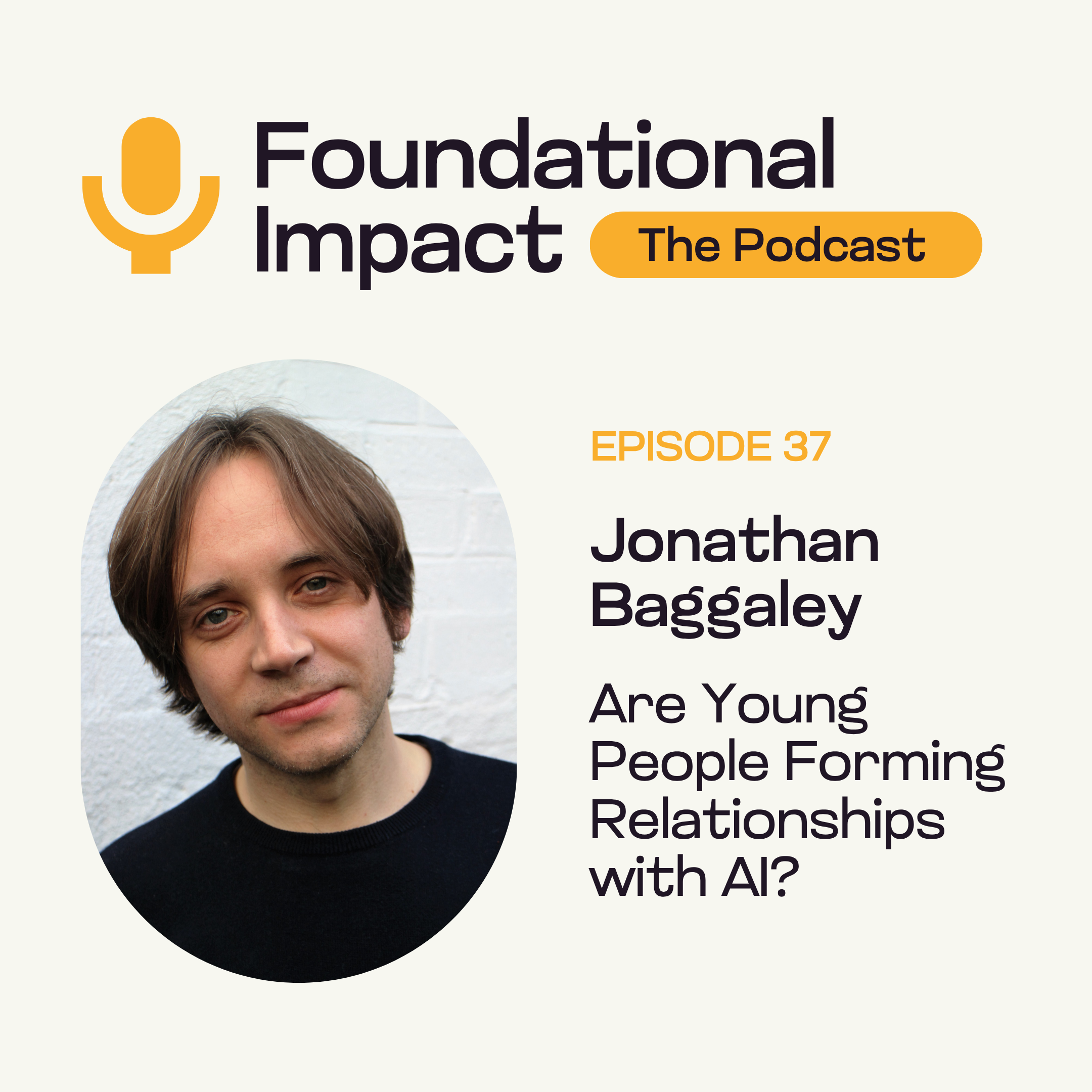

Jonathan Baggaley is Chief Executive of the PSHE Association, the national membership body and charity for personal, social, health and economic (PSHE) education, the school subject dedicated to preparing children and young people for life, and work. He has worked at a national level in education for many years, bringing particular expertise in educating young people about risks, harms and opportunities of online technologies. Jonathan led the Association’s successful efforts to improve PSHE education’s status on the curriculum, resulting in mandatory Relationships Sex and Health education in all schools.
Besides his CEO role, Jonathan is founder and editor of Fully Human – the PSHE Association’s research and development arm - which aims to better understand and negotiate the impact of technology on children’s lives. Prior to joining the PSHE Association, Jonathan was Head of Education at the Child Exploitation and Online Protection centre (now part of the National Crime Agency) leading an education programme used with millions of children and young people every year.
Videos
Transcription
Daniel Emmerson 00:01
Welcome to Foundational Impact, a podcast series that focuses on education and artificial intelligence from a nonprofit perspective. My name is Daniel Emmerson and I'm the Executive Director of Good Future Foundation, a nonprofit whose mission is to equip educators to confidently prepare all students, regardless of their background, to benefit from and succeed in an AI infused world.
Daniel Emmerson 00:28
Welcome everybody once again to Foundational Impact for what I'm sure will be a fascinating conversation today. I'm joined here by Jono, who I have to say, first of all, before we get into anything more formal, I need to ask you about the Sun Ra poster you have in the background. We're going to be talking about AI, of course, from the perspective of PSHE and the amazing work that you're doing in this space. But let's start this at a human level. Jono, before we get into that, tell us about Sun Ra.
Jonathan Baggaley 01:01
Let's start with Sun Ra. Well, I mean, we should always start with Sun Ra, if we can. So poster in the background is from when the orchestra came to Cafe OTO. The orchestra who are, for those who don't know, were see Sun Ra's extraordinary, extraordinary band orchestra, orchestra who after the Icelandic volcano, if you remember, back in 20.
Daniel Emmerson 01:24
The ash cloud.
Jonathan Baggaley 01:25
Yeah, yeah. Which. Which also came with the, the joke. Oh, you know, I was walking down the street the other day and I got hit by some frozen peas and a frozen leg of lamb. And yeah, it was the fallout from Iceland. So it's been, it's been 15 years since I've got to tell that joke. But the. They got stuck here because there was no, no flights.
Daniel Emmerson 01:47
Right.
Jonathan Baggaley 01:48
And so Cafe OTO put them on for three days or something like that. And then they did that regularly for a while. So this was from one of their residencies. I went a few times and it was always an extraordinarily, I think, coming back to that kind of deeply human, deeply connected experiences. And I think when we think about AI, there's a. There's a Sun Ra track which has the lyrics, somebody else's idea of somebody else's world. It's not my idea of things as they are. And this comes back to me a lot when we think about AI, because I think a lot of the time we're dealing with narratives and we're dealing with narratives that are being presented as inevitable, being presented as the way things have to be and the way things will be. And Sun Ra was obviously for lots of different reasons, you know, pretty much about race and position, if you know of black Americans at that time. And you know, and ongoing, you know, very much pushing against the kind of accepted narratives of what was, you know, what, as I say, what was being kind of pushed upon them. And I think for me, coming back to that, when we think about AI is really important to think about how do we create, ensure that we can, for our, you know, for young people and for ourselves, not just accept the narratives that are being foisted upon us.
Daniel Emmerson 03:13
Absolutely. And what a great place to start. And that venue as well, for folks who don't know Cafe OTO. It's a very small, intimate venue in Dalston that has brilliant, almost the most human performances that you could possibly expect from live music. And a brilliant, brilliant place to check out. Okay. It wasn't quite what I was expecting in terms of an introduction, but I saw that Jono and I just thought we have to, we have to go there. Could you. Let's get into our main theme for today. Tell us a little bit about your organisation and just a high level overview as to what you do. Because you work across a huge number of schools in the UK, it'd be brilliant to have that context.
Jonathan Baggaley 03:52
Fantastic. Yes. So I'm the CEO of the PSHE Association, which is the national body for Personal, Social, Health and Economic education, which is a terrible mouthful, but a wonderful thing. And so we're basically the subject association for PSHE. And as I'm sure you know, most would be aware, that's the school subject in England where we teach young people about health and relationships, including mental health, emotional wellbeing, but also physical health. So nutrition, self care, benefits of exercise, those things, as well as relationships. So that includes intimate and sexual relationships, but also our relationships as a friend, as a colleague, as a member of the community, and then also what we call sort of living in the wider world. So that's really thinking about your future. So that's careers, that's financial capability. And really, when we think about PSHE, what we're talking about is preparing children for life. It's about, it's about their lives right now, the experiences they might be having as they come up through school, but also thinking about what their lives are going to be like in the future. And of course, huge amount of all of our lives, not just children, young people, are now mediated by digital technologies, as evidenced just by this experience right now. We are communicating, you know, through sort of pixelated versions of ourselves and, you know, which is a totally normal experience for us, but we almost don't notice it anymore. And so many of aspects of our lives are mediated in this way that when we're thinking about teaching young people about their lives, we have to take that into account. So really important that we teach young people explicit skills around digital literacy, staying safe online. But for me and for us, it's, it's not about sort of siloing that as one part of the curriculum, it's about thinking about, okay, we're thinking about health. If we're teaching young people about accessing health information, we need to think about what does it mean to access health information on TikTok, for example, and why might the sort of information that you access on TikTok appear in certain, in a certain form? For example, you know, why is it that here are the three ways to tell if you've got OCD? Are you biting your nails and thinking about. Well, how do we understand why this is framed in this way? Well, it's, you know, part of this is about the influence of algorithmic content serving on the kind of content that we create, right. So you kind of can't disentangle those, those different things. So for me, it's about providing young people with a curriculum that really explores the whole of their lives, basically, whilst at the same time recognising, like, if you're teaching about sex and relationships and you're not teaching about nude image sharing, for example, or frankly now, conversations with chatbots and relationships with chatbots, then you're not doing relationships and sex education properly. But at the same token, if you're only talking about what's happening online, you're also not doing it properly because, you know, it's got to start with the human, basically. So that's, that's a bit about what we're about, what our aims are. Basically our aim is to ensure high quality PSHE education for every child. And we're a membership organisation, so we've got members in about 80% of secondary schools, about over a quarter of primary schools, but our reaches much wider than that because we also provide things like the program of study for the subject which maps it out from Key Stage 1 to 5, lots of guidance, lots of research, particularly on kind of emerging areas and emerging issues. We've done a lot around, again, particular on digital technologies. My background prior to the Association was at the Child Exploitation Online Protection Centre, which is now part of a national crime agency. So working at that intersection of children and emerging technologies, basically, and, you know, both the risks and the opportunities.
Daniel Emmerson 07:29
So I'm wondering, you know, there's a huge amount of ground you cover in the work that you do and you know, schools are notorious places for trying to find time to do things that aren't necessarily tied to, from a secondary school perspective, exam results and other various performance indicators that are. That are thrust upon them. How are you seeing that adoption of your curriculum and your content within your members change as mainstream AI has begun to alter the way that perhaps some of the content you might cover is being seen or being viewed in an online space?
Jonathan Baggaley 08:13
Yeah, it's a really good question. I think I probably answer this in two ways. I think at a structural level in UK schools or in English schools. The provision of PSHE in particular around relationships and sex education has improved significantly over the last decade. So we campaigned for many, many years for compulsory status for PSHE, because for years it was basically optional.
Daniel Emmerson 08:38
What is the time frame we're looking at for that, Jono? Just to give us.
Jonathan Baggaley 08:42
Well, that was, to go way back. We were formed in 2007 under Labour when they were going to make PSHE compulsory in all schools. So this is a long time ago now. There was a bill going through the House that I think it was the Children Children and Families Bill, I think that was going to make PSHE compulsory and it was going through at the point of the 2010 election. Then when the coalition came in, it got lost in what's called the wash up, when the incoming party and the outgoing party choose which bits of legislation will continue to go through, basically. And that was a really pivotal and kind of sad moment for the sector because people have been campaigning for that for years. And we went back to the drawing board and started campaigning again. And it took another seven years before the then Conservative government, under Justin Greening at the time, said, right, we're going to make relationships and sex education compulsory in all schools and we're going to consult on the rest of PSHE. And they consulted and out of that came, irritatingly, another acronym, just because it's an absolute minestrone soup of acronyms for this work. But which was Relationship, Sex and Health education, which is basically what is now the statutory content of the wider subject of PSHE. We see it as about 80% of PSHE is compulsory. The bits that aren't around financial capability and wellbeing. And that is now coming through in citizenship with the Curriculum Assessment review. But that's a whole other policy bundle. So that's. So ever since 2019, there's been guidance and that really came into force in 2020. So it's the last five, six years that schools have really started to embed these statutory changes. And I've got to say, the evidence is showing that it is having a really positive effect. So the Sex Education Forum do an annual survey of young people looking at their satisfaction with relationships and sex education. And I'm going to get the stats slightly wrong here because they're off the top of my dome. But we are soon publishing a paper off the back of this, which I will share the links with you. But basically, in 2022, something like 25%, 30% of young people felt that their relationships and sex education was good or very good. Last year, that rose to 52%.
Daniel Emmerson 10:59
Wow.
Jonathan Baggaley 11:00
So, again, it's still only half, but that's a significant increase. And also I would say if you ask young people, how satisfied are you with your geography lessons or lessons, they're not all going to say it's great, are they? You know, so, you know, so I think it's. It's a. It's really positive. The even more positive bit of it is that back in 2022, one in seven felt that their RSE was bad or very bad. And that's really concerning because this is a subject where you can actually actively do harm, you know, if you do it badly. Last year it was one in 50 felt it was bad or very bad. So there's a real improvement thanks to the statutory changes.
Daniel Emmerson 11:35
That's super helpful context. Have derailed us slightly. I wanted to talk about how particularly AI over the course of the last three years, which is relatively short when you've mapped out that timeline, or actually it's a big chunk, I suppose, if you said, you know.
Jonathan Baggaley 11:51
Yeah. So provide that structural context, just so people know, kind of there is this improving trajectory. But the problem that we face is we have a subject that is about children's everyday lives and their real experiences. And what we don't have effectively, is a fast enough feedback loop between the landscape of their lives and the curriculum. So we're trying to do a lot around that to keep pace with what's happening technologically, what's happening in all aspects of their lives, and then so that we can translate that swiftly into curriculum materials. But certainly where AI has been, you know, I mean, when we're talking about AI, obviously words like exponential or unprecedented or, you know, pace of change are always the phrases that come in. I mean, we were exploring voice AI within schools back in 2022. I was in schools the week that ChatGPT kind of launched there in beta. And so we were trying to explore some of this back then, and coming up with really interesting findings from what? From young people's experiences even then of sort of, they hadn't seen these kind of text generator machines, but when we talked to them about it, a lot of the issues that we're now seeing, they were identifying, saying things like, I'm really concerned about what might this mean for our real world friendships if these things are surrounding us. Particular concerns about, you know, concerns about jobs and displacement and all of those sorts of things. So we've been trying to explore this. But as I say, the in an area as fast moving and as frankly sometimes opaque as AI, where we are also dealing with very often conflicting narratives about this is going to save education and this is going to be an incredible productivity boost and we should be embedding this into everything versus a lot of what we're also seeing in terms of the very real risks of conversations and relationships with chatbots, things like deepfakes and those sorts of things. It's a real point of tension. And how do we support schools to, on the one hand in the wider curriculum they're doing some amazing work, but also some just knee jerk response work to the tools that are available and sort of say, hang on, there is a piece here that we really need to stop and start from the perspective of helping young people grapple with these technologies because we know they are using them as well. I think for too many young people, AI technologies are being introduced fairly haphazardly. You know, a teacher with very little guidance or support is sort of suddenly introducing ChatGPT or it's just there on the computer and it's just being introduced in a way rather than with these much, you know, just critical questions about what are you actually dealing with, what kind of system, you know.
Daniel Emmerson 14:48
So that haphazard approach, and that definitely reflects a lot of what we're seeing with, with schools across the board. And that's not intentional, right? A lot of that is, is due to how quickly the technology is evolving coupled with, you know, real concerns around particularly workload, but also re-engaging teachers and keeping people in the profession. So, you know, the tensions are very real there. But you mentioned relationships specifically and I wanted to, to explore that a little more. How is, you know, in the broadest possible terms that haphazard approach of AI introduction, how is that impacting relationships? How is this sort of mainstream consumer AI technology impacting young people right now when it comes to their relationship choices?
Jonathan Baggaley 15:42
So I think we are, as with many, you know, very concerned about, I mean, fundamentally young people and adults frankly forming relationships or feeling they are forming relationships with chatbots. And just how swiftly this can happen. Both with the active AI companion bots which are marketed as providing friendship or often sexual relationship. And many of those are sitting on top of models which have questionable safeguards. But also with the more closed models, your Open AI or you know, chat GPT or Gemini, the, the evidence seems to indicate that people are also forming relationships with these more functional models as well. There's a, there was a study on looking at a Reddit sub thread of my, my AI girlfriend which found that of those people who had AI girlfriends and there were many, I can't remember what the stats were, but it was the majority, you know, maybe 60, 70% hadn't gone looking for AI girlfriends or boyfriends. They've been chatting to ChatGPT and just sort of, you know, got a bit heated basically. Now some of this is to do with the earlier GPT4, which you know, was much more sycophantic and much more open to opening into romantic relationships, but the risks are very much there. And so I suppose the concern with schools is if young people are being presented with chatbot interfaces as part of their educational experiences and these are normalised and that sense that these probabilistic automation systems are something that we use in day to day life, it's only going to be natural for them to continue those conversations, possibly look for AI chatbots that are more open to emotional attachment and engagement and potentially sexual chat as well. So that's a, that's a real concern and I think it's the real challenge that we face is that I think it's incredibly hard not to feel like you are in dialogue with something real when you're dealing with these chatbots. Because we are as humans, we are sort of primed to anthropomorphise. When I use one of the chatbots, I’m relatively well informed about what large language models are and how I'm dealing with a probabilistic automation system. People prefer to use that kind of language dealing with a conversation simulator. But there have certainly been times when I've been chatting where I've felt the presence of something, where I felt I am in dialogue with something, that there is something weighing its words and communicating with me, despite the fact that I'm sort of hardwired and fairly opposed to the very idea of this. So how do we effectively build resilience to our instinctive need and well, not need our instinctive urge to anthropomorphise? Because the studies find that, you know, children as young as 12 months old, when they're shown things like a circle and another circle moving in the same direction, they will assume that this, the one circle is following the other and if it does something else, they will be surprised by that. So they're already imputing intention and agency to non-human things. Again, preverbal children associate being alive with language, with being able to communicate, even if they themselves can't actively use language. So we're hardwired to think that things in the world have conscience . So how do we support young people when dealing with fundamentally really sophisticated language machines to not do that?
Daniel Emmerson 19:52
So I mean, first of all, I'm intrigued as to your views on whether or not relationship is, is the right word here. Secondly, I'd like to ask a bit more about, based on what you understand about whatever it is, relationship or otherwise, that young people are forming with this technology, how schools can support conversations around understanding what's, what's behind it and does that have an impact?
Jonathan Baggaley 20:18
Yeah, absolutely. So I think on the question, can we talk about this as relationships? I would argue that we should certainly be moving to the use of words where no relationship doesn't make sense. Because fundamentally you are alone, you are alone with your browser and you are engaging with a system that, you know, a probabilistic automation system and actually changing some of this language. The fact we talk about chatbots implies that this is somehow the same as chatting, as conversing, which is absolutely not. We're engaging in a sort of mathematical processes, albeit extraordinarily complex ones, which do some incredible things. But I think we have to start with young people of there has to be a bit of understanding the technology. And I think that's where there's got to be in the computing curriculum bit here. Understanding, for instance, the move from rule based AI systems to data driven ones, which then gives you this sense of like, okay, well why might it, what data is it being trained on? You can then start to think about those questions and you can start to think about, okay, so why might it be normalising things that are actually unusual behaviors if it's been trained on a huge amount of sexual chat from particular communities, for example? So you can start to think about that. So there's a computing bit, I think there's a politics bit in citizenship. There's understanding the, certainly understanding the environmental impact of AI as well, a lot of young people. It sort of increases your resistance to anthropomorphism if you have an understanding that actually these machines are not neutral entities. And then also not just floating out there in the cloud, that they are made of rare minerals. You know, there are sulfur lakes in Mongolia that are the product of, you know, the mining of these things that tap water's not coming out in all sorts of places. You know, all of those questions about the ethics and politics of data centers and the geopolitics of it as well, that kind of, you know, it's extraordinarily terrifying and fascinating at the moment. But then in PSHE, if you understand those things, you've got this kind of depth of knowledge of the sorts of systems that you're dealing with, then we can really start to unpack, building on the teaching that we do around healthy relationships. Positive. How do you form a positive relationship? What are we looking for from each other? We can start to compare and contrast what you might be getting from a chatbot versus what you might to expect from a human. And it is, you know, we can then start to take a much more nuanced, hopefully approach to this so that there is a position of being able to say, well, I think that there's a really interesting paper about asking what are we actually doing when we're talking to chatbots? Um, I won't go in in depth, but like in philosophy of linguistics, there's a sense, many people would argue that the outputs, the language outputs of chatbots are actually quote, unquote meaningless because on most theories of language, they don't actually meet the bar of meaning because there's various different theories of why. But obviously they're not meaningless because we can read them and they break. They. They make sense to us. So within, with the ivory towers of philosophy, there's kind of. It's meaningless. So philosophers trying to work out what is it, what are we doing? And I really like this idea that what we're really engaging with is it a kind of role play. It's a kind of fantasy that is a fiction, basically. So we're almost like engaging in live fictional creation. And if we can keep it on that side, that what you're an understanding that there is a fiction here, then maybe that's okay. I'm not saying it definitely is because I think, particularly for young people whose identity is developing their sense of the world, is developing their sense of relationships, think that's quite problematic. But I'm just trying to say, I'm not necessarily saying we have to throw out all possibility of engagement with chatbots, but we do have to support young people to understand that they are not dealing with beings and also that the sorts of things that might be normalised for some of these things, particularly on some of the models, you know, if you're engaging with an AI companion that's built on an open source model that's been obliterated, that is, all the safeguards have been taken off, then who knows what it might suggest is normal in the realm of sex and relationships, and what does that then do to your sense of relationship as well? And we spent a long time worrying about that with pornography. And I really worry about what chatbots might do there.
Daniel Emmerson 24:44
Well, I suppose the big concern there is that in spite of the fact that whatever that interaction, or however we might describe that interaction, if indeed it is even an interaction, is synthetic, a lot of the design principles around the consumer AI chatbots that we're talking about here are built so that there's very little friction or judgment, and they're designed to be a lot easier to interact with versus what you might otherwise get with a human being. And if we look at age authentication, for example, for some of these more adult models, it is just a tick box in a lot of cases. So is that a battle that we, you know, as educators, as people working in schools, how to approach that, I suppose is my question. When knowing and understanding that these models are readily available, they're easy to access, and they give young people that sense of ease when it comes to engaging with them. That's how they're designed, that's what they're built for. Do we, do we really stand a chance?
Jonathan Baggaley 26:04
I think what gives me hope is that young people are not fools. You know, I mean, they're. Young people are just humans, like all of us. And, you know, there's a whole range in there. But fundamentally, when young people are made aware of the realities of what they're actually dealing with, particularly, and when they're made aware of things they care about, like the environmental cost, it increases, they are willing to increase the friction, if you like. And that they are. They recognise, you know, certainly, you know, some of the initial research of exploring this with young people seems to. They recognize the risks of frictionless communication. I think the challenge comes in where we all have a desire for ease, and that is what we are being sold with this. So if we can increase their understanding of the systems they're dealing with, if we can increase their understanding of what are some of the risks here, what are you trading for ease as well? I think in the context of just a lot of the thing we've done around pornography over the years has been there is also an ease in accessing pornography contrast to real sexual relationships for all sorts, in all sorts of ways. But you are trading there are real risks to your ability to form intimate relationships in the future, as some of the research indicates. So again with these chat bots. When we first spoke to young people about this back in 2022, they said like, if, if this thing's telling me all the things I want to hear, well, how am I going to go? And like when I go and chat to my mates and they definitely don't tell me the things I want to hear, what's that going to do to my sense of what it means to be a friend, what friends are for and that desire to retreat? I think the risk is, of course, it's hard to maintain a more frictionful stance. And if things go wrong for you in your life, if you're particularly vulnerable at a time, if you're feeling really low and there's a machine out there that will make you feel a bit better, albeit temporarily, then of course you're likely to engage with that. And I think it's those that's a real issue. But I think where we have to start, which is to move away from a haphazard introduction, have a more consistent from primary up to, you know, through, through to secondary. Let's at least give children a chance by letting them know what these systems are, giving a sense of how they sit in our wider society and giving them the support to know where they can get help if they are concerned about themselves or a friend. And we've got a suite of lessons coming out later this term, so we're in the summer term, so sort of just before May, June. And that's again looking across the piece at the kind of ethics, the environmental cost, taking a rights based approach, but very much delving into this question of what is it to form relationships with these things and questions around. Yeah, also the production of images and deepfakes and that sort of thing.
Daniel Emmerson 28:59
So just one final question for me then, Jono. When we're speaking to schools about what responsible AI adoption might look like in their context, the immediate assumption is that we're automatically talking about either teachers or young people using the technology in order to know and understand it better and to develop their skills in that space. How much of this do you think is about conversation and mapping scenarios and looking at research versus using the technology itself?
Jonathan Baggaley 29:30
I think the missing bit is the conversation and scenarios and talking about the wider context of the technology. Fundamentally the educative bit about what you're actually dealing with, none of which requires using the technology. I think you do, then, of course, as with all technologies, need to have that direct engagement bit in, in order to know what you're dealing with. But for me, the priority should be starting with the wider context of what we're dealing with. Because also young people, as we've already said, whether or not we're introducing the technologies in schools, they are going to encounter them. They'll be encountered. Many of them will have encountered them already. Probably most of them would have encountered them already by secondary. So the role of schools here can really be to situate these technologies in a much wider context and give young people the confidence to say yes or no to them as well. To say, well, do you know what? Actually, yeah, I can see some of the benefits here, but I'm not going to have those chats because frankly, you know, I don't get good vibes from it or whatever, you know.
Daniel Emmerson 30:38
John, some fantastic reflections for the audience today and I look forward to being able to share some of those resources with our community as well. Thank you so, so very much for your time and for being such a wonderful guest on Foundational Impact.
Jonathan Baggaley 30:51
Not at all. Absolute pleasure anytime.
Voiceover
That's it for this episode. Don't forget, the next episode is coming out soon, so make sure you click that option to follow or subscribe. It just means you won't miss it. But in the meantime, thank you for being here and we'll see you next time.